Digital Reconstruction
Mapping the Unseen
"They wiped the village from the map, but it remains breathing in the memories of its people."
Historical Map of Saqiya (1942)
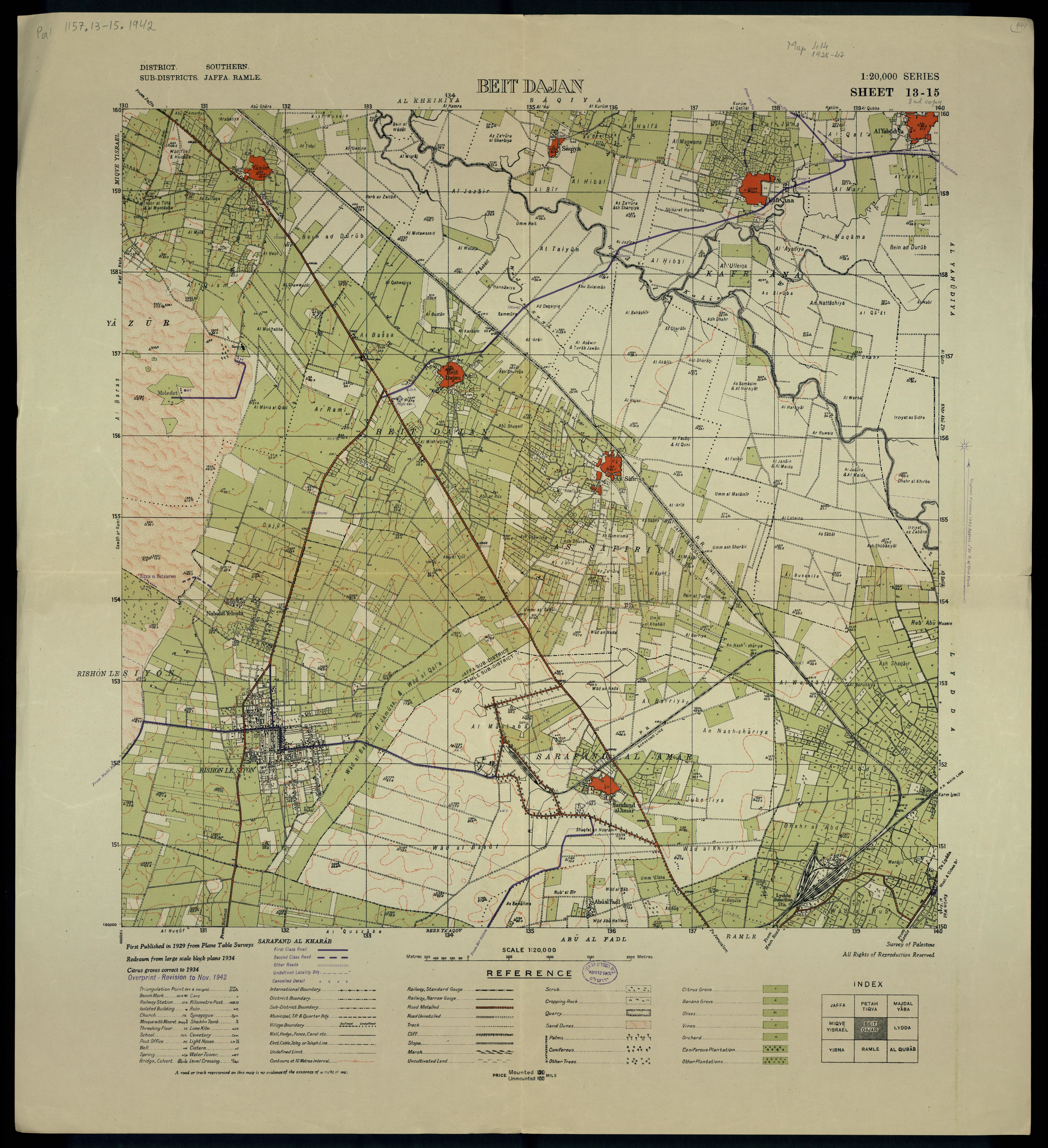
Survey map of Jaffa district showing the village boundaries and its agricultural lands.
History & Geography
1. Introduction: The Geopolitical Significance
The history of Saqiya is not merely a chronicle of a single settlement but a microcosm of the broader demographic, economic, and political transformations that shaped the Jaffa hinterland over the last half-millennium. Located 8.5 kilometers east of Jaffa, Saqiya existed at the intersection of ancient agricultural traditions and the rapid modernization brought about by the global citrus trade.
Contrary to narratives suggesting the coastal plain was devoid of settled habitation until late migrations, Saqiya represents a continuous, evolving community documented as early as the 16th century.
2. Etymology: The Hydraulic Engine
2.1 Technological Determinant
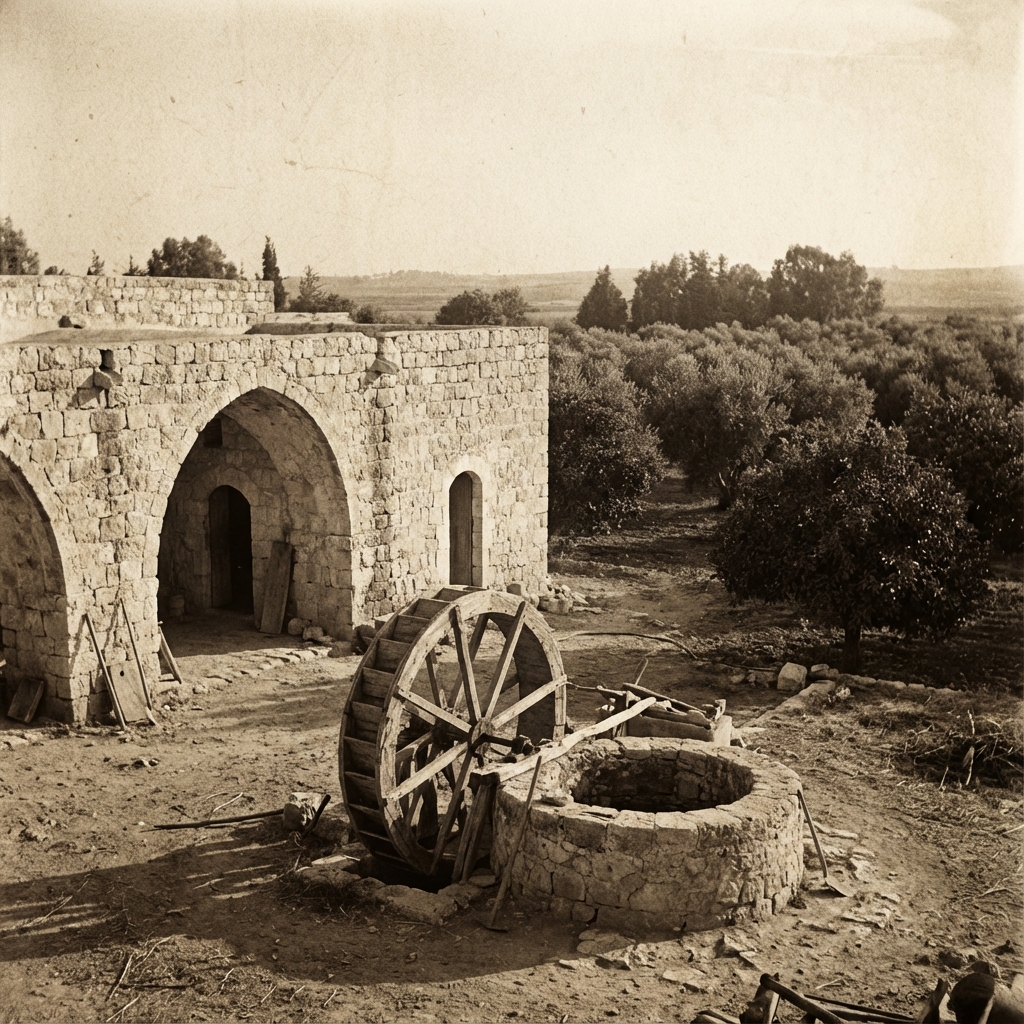
In Arabic, Saqiya (ساقية) refers to a water wheel, specifically an animal-powered mechanism used to lift water from a well to an irrigation ditch. Unlike the noria (driven by river currents), the saqiya utilize gears to convert the circular motion of a draft animal into the vertical lifting of water jars.
The naming of the village “Saqiya” implies that this device was its defining feature. While hill villages were named after topography, Saqiya was named after its infrastructure. This mastery of hydraulic engineering allowed for intensive summer crops (citrus and vegetables) rather than just winter cereals.
2.2 Social Complexity
Maintaining a saqiya required specialized carpentry, a steady supply of draft animals, and complex social management of water rights. This stability predates the Ottoman conquest, suggesting the village coalesced around a central irrigation complex that served as its economic heartbeat.
3. Founding: Chronology and Records
3.1 The 1596 Ottoman Tax Register
Saqiya is explicitly recorded in the 1596 Defter-i Mufassal in the Nahiya of Ramla. The register describes a fully functioning, thriving village rather than a new outpost.
Socio-Economic Profile (1596)
| Metric | Value | Implications |
|---|---|---|
| Households | 49 | A settled core population of families. |
| Est. Population | ~270 | A medium-sized village for the era. |
| Composition | 100% Muslim | Religious homogeneity in the early modern period. |
| Taxable Assets | Wheat, Barley, Sesame, Fruit | Diversified subsistence and cash crops. |
| Livestock | Goats, Beehives | Supplemented by pastoralism and apiculture. |
The existence of 49 households in 1596 suggests the village was likely established significantly earlier, potentially during the Mamluk period (1250–1517) or the early Arab period.
3.2 The 18th Century: Survival and Connectivity
The Syrian Sufi traveler Mustafa al-Bakri al-Siddiqi passed through Saqiya in the mid-18th century. This mention confirms that the village survived the turmoil of the 17th/18th centuries—a period of declining central authority—and remained a node on the primary route connecting the interior to the port of Jaffa.
4. Historical Geography
4.1 Local Connectivity
Saqiya was a bridge between the urban coast and the interior. It was linked by roads to:
- Kafr ‘Ana (North)
- Al-Khayriyya (West)
- Bayt Dajan (South)
- Lydda District (East)
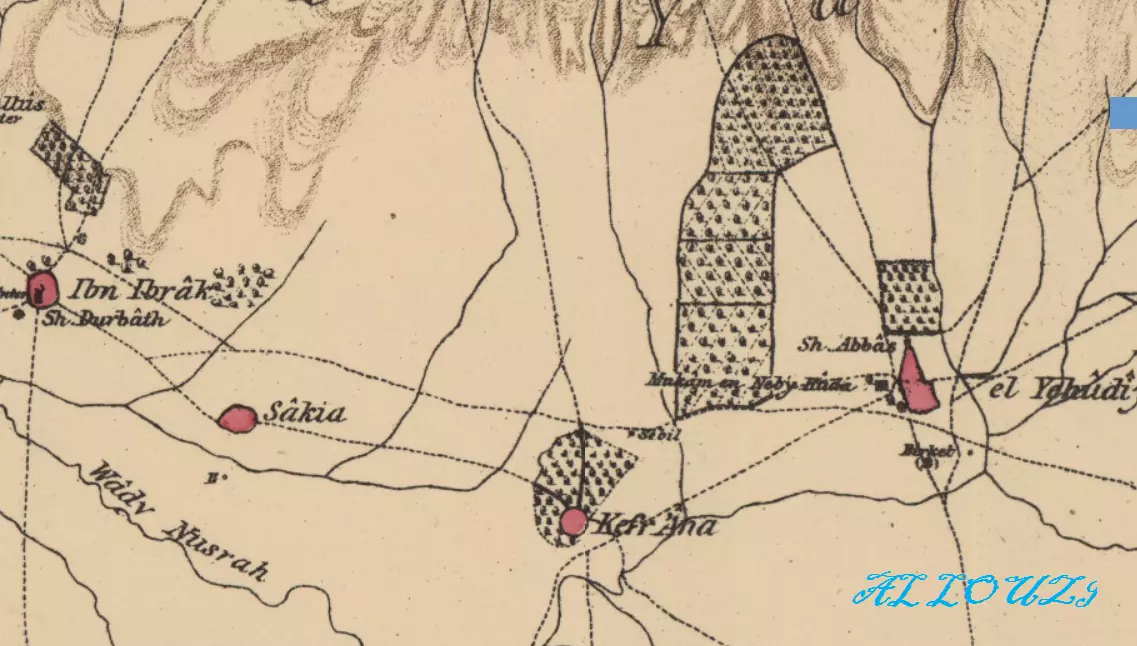 Historical map from 1880 showing the village and its neighbors.
4.2 Mapping the Core
The Survey of Palestine (Sheet 13-15) shows a dense residential core of stone and adobe, which expanded significantly with concrete buildings during the Mandate era as wealth from the citrus orchards poured back into the village.
Introduction: The Hydraulic Heritage
Saqiya: A Historical and Archival Reconstruction
The creation of saqiya.org is not merely an act of memorialization; it is a complex project of historical reconstruction. Located in the Jaffa District of Mandate Palestine, Saqiya (Arabic: ساقية) represents a specific typological case study of the Palestinian coastal plain: a village that transitioned rapidly from traditional subsistence agriculture to the intensive, capital-rich citrus economy of the 20th century, only to be depopulated and physically erased in 1948.
The Semiotics of “Saqiya”
The name “Saqiya” acts as a linguistic fossil, preserving the technological history of the site. Derived from the Arabic root s-q-y (سقي), meaning “to irrigate” or “to give water,” the toponym refers specifically to the saqiya (or sakia), a mechanical water-lifting device that was ubiquitous in the pre-modern Middle East.
This etymology is strictly technological: it suggests that the settlement coalesced around a specific piece of infrastructure—a community-maintained water wheel—that allowed for the exploitation of the coastal aquifer long before the advent of diesel pumps.
The Mechanics
To understand the village, one must understand the machine. The saqiya differs from the noria. While a noria is passive, driven by a river, the saqiya is active, driven by animal power to lift water from a stationary well. The creaking of its wooden gears would have been the background drone—the industrial music—of village life.
History: From Ottoman Tax to Mandate Boom
The Long History
While the archaeological record suggests ancient habitation, the archival history of modern Saqiya begins in the early Ottoman period.
The 1596 Tax Register
In 1596, Saqiya was recorded in the Defter-i Mufassal (Tax Register) as a village in the Nahiya of Ramla. The population was 270 persons (50 households). The economy was based on:
- Wheat and Barley: Dry farming cereals.
- Sesame: A cash crop for oil.
- Beehives: Indicating a landscape rich in wildflowers.
The Mandate Boom (1920–1948)
The arrival of the British and the rapid integration of Palestine into the global capitalist economy transformed Saqiya.
Architectural Evolution
During the 1930s and 40s, “concrete buildings appeared,” signaling a shift in prosperity. The adobe brick, associated with the fellah past, gave way to reinforced concrete. This architectural hybridization—mud brick centers wrapped in concrete peripheries—was characteristic of the coastal villages on the eve of the Nakba.
The School (1936)
Perhaps the most significant indicator of modernization was the founding of the boys’ elementary school in 1936. By the mid-1940s, this school had 136 students and owned 16 dunums of land dedicated to agricultural training. The village was training its youth not just in literacy, but in the scientific management of the orchards that sustained them.
Society & Economy
4. Origins of the Populace: A Demographic Tapestry
The “people of Saqiya” were a composite of three distinct demographic layers:
- The Indigenous Core (The Fellahin Base): The 1596 tax record establishes a continuous Muslim presence for at least four centuries. Genetic and cultural continuity suggests the core families were sedentary inhabitants of the region who evolved in place.
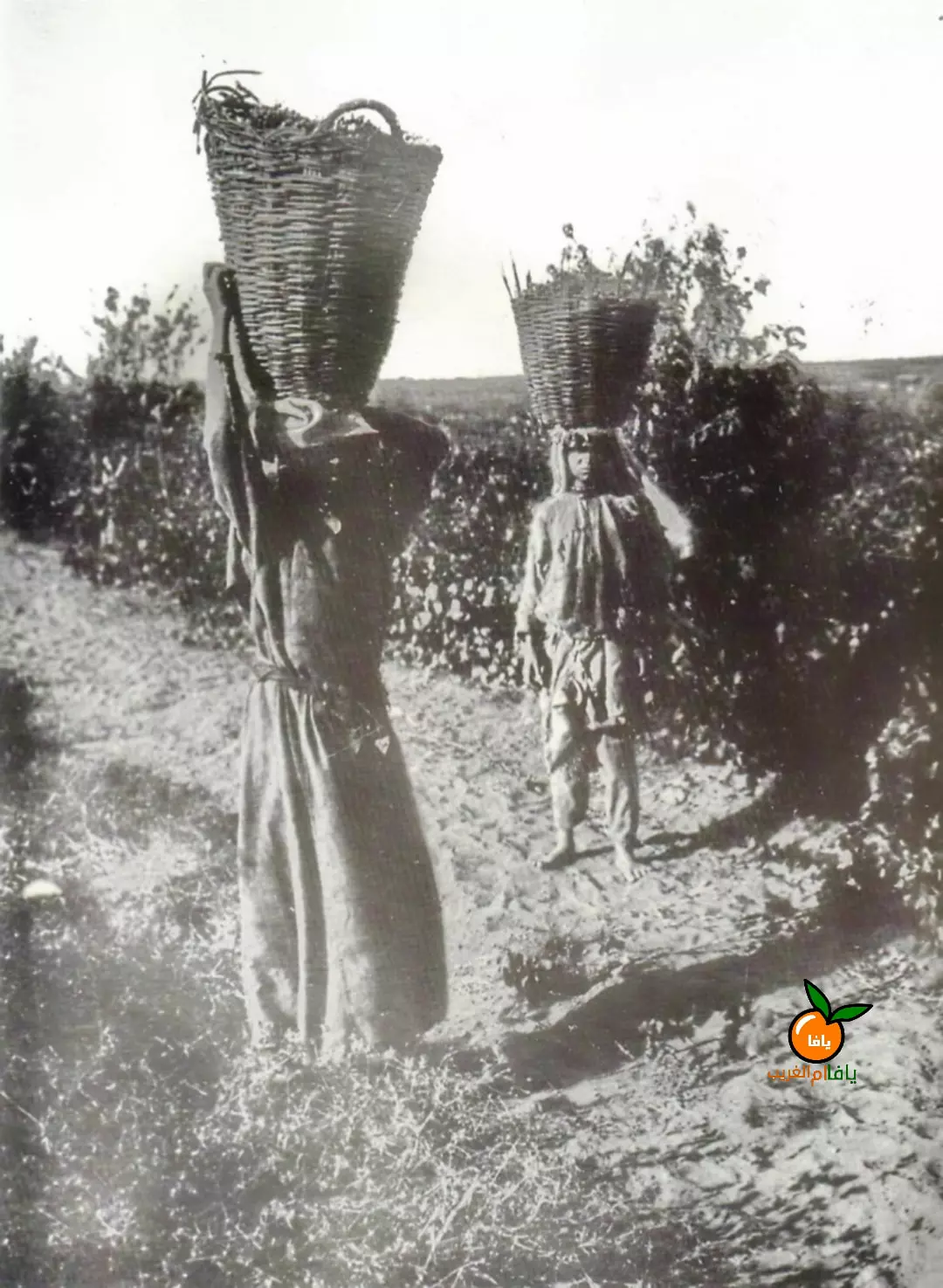 A rare 1922 photograph of women from Saqiya harvesting grapes.
- Internal Highland Migration: During the late Ottoman period, improved security led to a drift of families from the resource-poor mountains (Hebron, Nablus) to the fertile coast, drawn by the “Orange Boom.”
5. Social Structure and Genealogy: The Clans
The social organization was centered on the Hamula (clan), the primary unit of social security and political representation.
5.1 Prominent Families
- Al-Nadi: A land-owning elite who held the Mukhtarship for significant periods.
- Atta (Attia): A dominant political force holding the “First Mukhtar” position as early as 1916.
- Al-Badri: Shared the Mukhtarship during the Mandate era to maintain clan balance.
- Al-Jawhary: A registered family with a significant diaspora presence today.
- Other Clans: Abu Ajwa, Abu Hashish, Damisi, Sallam, and Al-Sheikh Hassan.
5.2 The Institution of the Mukhtar
Late Ottoman Period (c. 1916):
- First Mukhtar: Hassan Hussein Atta.
- Second Mukhtar: Mustafa Nadi. (This dual structure prevented any single family from monopolizing village influence).
British Mandate (1930s-1940s):
- Mukhtars: Sheikh Hussein Abd al-Al al-Nadi, Sheikh Yusuf al-Badri, and Jaser Muhammad Ali Atiyeh.
6. Demographics and Economy
6.1 Population Growth (1922–1948)
| Year | Source | Population | House Count |
|---|---|---|---|
| 1922 | British Census | 427 | - |
| 1931 | British Census | 663 | 142 |
| 1945 | Village Statistics | 1,100 | - |
| 1948 | Pre-War Estimate | ~1,276 | 273 (est) |
6.2 The Citrus Revolution (1945 Data)
Saqiya was a powerhouse of citrus production. Over 40% of the land was dedicated to cash crops.
| Land Use Category | Area (Dunams) | Insight |
|---|---|---|
| Citrus & Bananas | 2,422 | Over 40% of total land area. |
| Cereals | 2,534 | Maintained for self-sufficiency. |
| Irrigated/Orchards | 145 | Vegetables and soft fruits. |
| Total Land | 5,850 | Owned ~88% by Arabs. |
Analysis: This was a highly monetized economy. Villagers were not just peasants; they were farmers engaged in international trade capitalism through the Jaffa Port.
6.3 Infrastructure & Education
- Architecture: Transitioned from adobe to modern concrete in the 1940s.
- Education: A boys’ elementary school founded in 1936 with 16 dunums of land for agricultural training.
- Religion: A new mosque opened shortly before the end of the Mandate, a symbol of civic pride.
The Nakba & Aftermath
7. The 1948 War: Operation Hametz
Saqiya’s location 8.5km east of Jaffa placed it directly in the path of the Zionist strategy to isolate the city.
7.1 Strategic Context: The Siege of Jaffa
In late April 1948, the Haganah launched Operation Hametz (referring to the Passover leaven). The goal was to conquer the ring of villages—Saqiya, Salama, Yazur, and Kafr ‘Ana—cutting Jaffa off from reinforcements and reinforcement.
7.2 The Assault (April 25–28)
- Attackers: Spearheaded by the Alexandroni Brigade, with support from Kiryati and Givati.
- Military Dynamics: The village faced heavy mortar barrages. While some logs claim it was taken “without a fight,” this typically implies the civilian population fled under the intensity of shelling or the news of nearby massacres.
- Capture Date: Israeli records cite April 25; Palestinian accounts and international press (AP) place the fall on April 27–28.
7.3 The Trail of Dispossession
Residents fled primarily toward Lydda and Ramla. In July 1948 (Operation Danny), they were expelled again on the “Death March” toward the Jordanian lines. This double displacement explains the scattered nature of Saqiya’s survivors today.
8. The Diaspora and Memory
8.1 Fragmented Geographies
- Gaza: Survivors in Jabaliyaformed the “Jaffa Neighborhood” (Hayy Jaffa), maintaining Jaffa’s dialect and customs as an act of resistance.
- Jordan: A complex status crisis where “Ex-Gazans” (twice-displaced) hold temporary passports without full national rights.
8.2 Physical Erasure & Or Yehuda
In 1950, Israel established Or Yehuda on village lands, initially as a ma’abara (transit camp) for Jewish immigrants.
- Extant Remains: Forensic surveys identify approximately ten original houses. Some are used as workshops; others are inhabited. Wide lancet arches and concrete facades from the 1940s remain visible as ghostly reminders.
8.3 Preservation of Memory
The oral history projects of elders like Mahmoud Abu Salim and Kamil al-Nadi serve as the repository of a history that physical demolition attempted to erase.
Society: Families and Structure
Social Structure and Leadership
The population of Saqiya grew explosively during the Mandate, doubling in under two decades (from 663 in 1931 to over 1,100 in 1945). This growth necessitated new forms of leadership.
The Families (Hamulas)
The digital archive highlights the prominent families who constituted the village’s social backbone:
- Al-Nadi: A dominant family that held significant political power.
- Al-Badri: Another leading clan, often sharing the Mukhtarship.
- Al-Demisi: A large family with branches including Ahmad, Yusuf, Ibrahim, and Mustafa.
- Al-Sheikh Hassan, Al-Dalie, and Al-Atiyeh.
The Mukhtars
The office of the Mukhtar evolved from an Ottoman tax role to a complex administrative position. By the late Mandate, Saqiya had a tripartite leadership:
- Sheikh Hussein Abd al-Al Nadi (First Mukhtar)
- Sheikh Yusuf al-Badri
- Jaser Muhammad Ali Atiyeh
This coalition style of governance was likely necessitated by the increasing complexity of village affairs during the Arab Revolt (1936–1939).
The Madafeh (Guest House)
Social life centered on the madafeh. While originally communal, prosperity led to private madafehs in the homes of notables. These were the village parliaments: large arched structures (‘aqd) furnished with wool rugs where disputes were arbitrated and resistance against the British and Zionists was debated.
Contribute to the Archive
We are actively seeking oral histories, family photographs, and archival documents related to Saqiya.
Contact Us